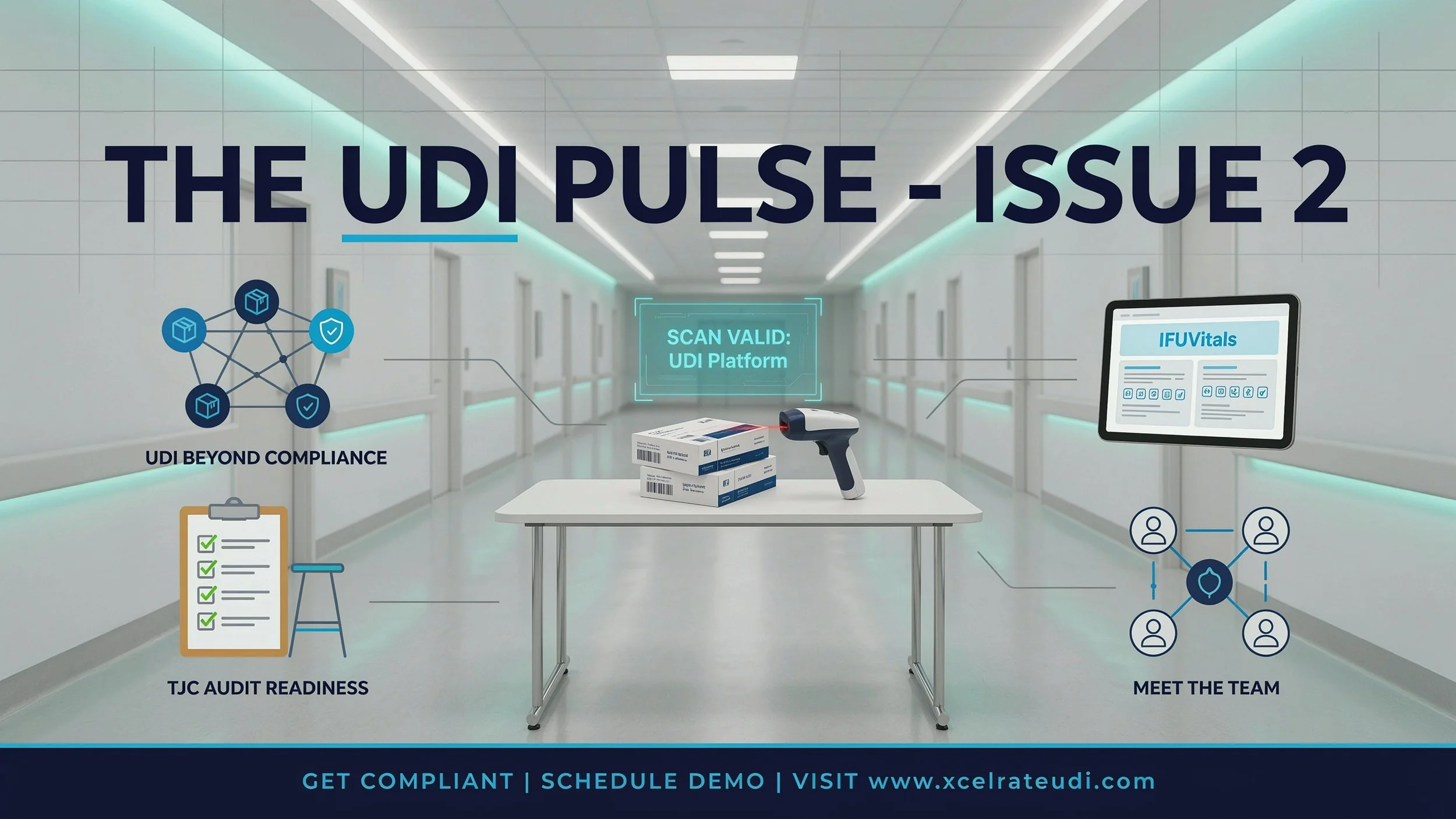
Welcome to Issue 2 of The UDI Pulse, your strategic briefing on medical device data, operational compliance, and point-of-use patient safety.
In this edition, we explore how Unique Device Identification (UDI) serves as a foundational engine for healthcare interoperability and safety, examine how standardized IFU access protects health systems during workforce transitions, provide actionable guidelines for year-round accreditation agency (i.e. The Joint Commission) audit readiness, and introduce the leaders driving innovation across the Xcelrate UDI platform.
-
For many healthcare organizations, Unique Device Identification (UDI) programs began as a mandatory regulatory requirement. Today, leading health systems are discovering that UDI data is much more than a check-the-box exercise. When leveraged effectively, UDI data becomes a powerful engine that drives operational, financial, and patient safety improvements across the entire enterprise.
What is UDI and Why Does It Matter?
A Unique Device Identifier (UDI) is a system of numeric or alphanumeric codes created by the FDA to adequately identify medical devices through their distribution and use. A complete UDI consists of two essential parts:
Device Identifier (DI): A mandatory, fixed portion that identifies the specific model or version of a device and the labeler.
Production Identifier (PI): A conditional, dynamic portion that includes details such as the lot or batch number, serial number, expiration date, and manufacturing date.
The Pillars of Value: Interoperability, Traceability, and Safety
While UDI compliance was mandated for regulatory oversight, its real power lies in how it transforms health system operations:
Interoperability: UDI provides a standardized, universal language across disparate healthcare IT platforms. By bridging supply chain software, inventory systems, clinical information systems, and Electronic Health Records (EHRs), UDI eliminates data silos and reduces manual transcription errors.
End-to-End Traceability: UDI allows health systems to track a medical device or biologic seamlessly from manufacturer delivery to point of care, implant, and post-procedure monitoring. In the event of a recall, teams can pinpoint affected inventory across multiple facilities within seconds rather than days.
Enhanced Patient Safety: Point-of-use scanning validates product authenticity, verifies expiration status, and triggers immediate alerts for active recalls or FDA warnings before a device ever touches a patient.
The Xcelrate UDI Platform: Unlocking Full Enterprise Potential
Xcelrate UDI transforms raw UDI data into actionable intelligence through an integrated suite of cloud-based solutions designed to automate medical device and biologic management.
UDIClearinghouse (Centralized Intelligence & Real-Time Alerts): Serves as the central intelligence engine, linking local inventory to official FDA GUDID data, safety notices, and manufacturer databases. Organizations gain full visibility into usage trends, recall updates, and compliance reporting, drastically reducing administrative burden while increasing operational transparency.
IFUVitals (Point-of-Need Access to Verified Documentation): Connecting UDI data directly to manufacturer documentation, IFUVitals gives sterile processing (SPD), operating room (OR), and clinical teams instant access to current Instructions for Use (IFUs), manuals, SDS, and CE documents. AI-enhanced search capabilities allow staff to locate specific reprocessing steps, temperature parameters, or handling criteria in seconds—eliminating outdated binders and risky guesswork.
UDIVitals (Real-Time Inventory & Recall Tracking): Delivers active monitoring across consignment, loaner, bill-only, and facility-owned inventory. By tracking expiration dates, recall status, and regulatory changes in real time, UDIVitals helps supply chain teams eliminate waste, optimize stock levels, and protect clinical departments from expired product usage.
UDIVerify (Instant Point-of-Use Protection): Designed for fast-paced clinical environments, UDIVerify provides point-of-use scanning validation. Before an item is opened, handed off, or implanted, staff receive clear, immediate feedback. If an issue is detected—such as an expired product, active recall, or invalid FDA status—UDIVerify triggers instant warnings to halt use immediately.
Transforming Compliance into Strategic Advantage
Unlocking the full value of UDI requires moving past passive compliance and adopting an active, automated infrastructure. When UDI data flows seamlessly from receiving to the electronic health record, healthcare organizations achieve a rare triple win: reduced supply chain waste, total audit readiness, and an uncompromised barrier of patient safety.
Key Takeaway: UDI is not just a barcode; it is a standardized data foundation. Combining UDI scanning with automated validation replaces manual assumptions with enterprise-wide clarity and real-time point-of-use protection.
-
Healthcare organizations across the country continue to face staffing shortages, turnover, and the ongoing challenge of onboarding new employees while maintaining high standards of patient care. During periods of workforce transition, it becomes more important than ever to ensure that critical knowledge is accessible, consistent, and easy to follow.
Overcoming the Loss of Institutional Knowledge
One of the biggest risks associated with staff turnover is the loss of institutional knowledge. Experienced team members often become the go-to source for questions about device reprocessing procedures, manufacturer instructions, and compliance requirements. When those individuals leave, valuable knowledge can leave with them.
By providing instant access to validated manufacturer Instructions for Use (IFUs) through IFUVitals, organizations reduce reliance on individual expertise. Rather than searching through paper binders, shared drives, or relying on memory, staff can quickly locate the exact information they need at the point of care. Crucially, IFUVitals obtains IFUs directly from device manufacturers, guaranteeing access to the most current instructions available. Staff no longer have to wonder whether they are using the latest version, reducing uncertainty and supporting complete regulatory compliance.
Creating Standardized Workflows Across Shifts and Facilities
Standardized access to IFUs creates consistency across departments, facilities, and shifts. Whether a team member is a seasoned technician or a newly hired employee, everyone follows the same manufacturer-approved guidance. This supports standardized device reprocessing workflows, improves compliance, and eliminates variation that can compromise patient safety.
For organizations onboarding new staff, easy access to trusted instructions significantly accelerates training. New employees gain confidence faster when they have a reliable resource available at the point of use, helping them become productive team members more quickly. Experienced staff also benefit from having a consistent reference point, reinforcing competency across all shifts.
Key Takeaway: Workforce transitions do not have to increase compliance risk. By standardizing access to validated, manufacturer-sourced IFUs with IFUVitals, healthcare organizations remain resilient, compliant, and prepared for the future.
-
When external surveyors arrive, preparation should not begin that day. The most successful organizations build survey readiness into their everyday processes, creating an enduring culture of compliance, consistency, and accountability.
Drawing from guidance shared by Joan Melendez, CEO of Xcelrate UDI, here are five practical ways healthcare teams can maintain continuous, year-round survey readiness:
1. Ensure Rapid Access to Validated Manufacturer IFUs
Surveyors frequently ask staff to demonstrate how they access Instructions for Use (IFUs) for medical devices and instrumentation. Teams must be able to quickly locate the most current, manufacturer-validated IFU without searching through multiple systems or paper files. IFUVitals supports this effort by providing a single source for device information and associated IFUs, helping teams retrieve documentation instantly when questioned.
2. Simplify IFU Search Workflows
Even when IFUs are stored, finding them under pressure during an audit can be a challenge. Organize documentation in a way that mirrors actual clinical workflows—whether by manufacturer, device type, asset number, barcode scan, or department. Leveraging tools like IFUVitals that link UDI data directly to documentation eliminates unnecessary searching during audits and daily operations.
3. Verify Complete Supporting Documentation
IFUs are only one piece of the compliance puzzle. Facilities must also confirm that supporting documentation—such as validation records, policies, procedures, competency logs, and equipment maintenance files—is readily available. Conducting periodic internal audits helps identify gaps before surveyors arrive.
4. Follow a Clear Escalation Process for Missing Documents
No organization is immune to an unexpected surveyor question or missing document. What matters is having a clear, documented escalation process. Staff should know precisely who to contact and what steps to take to obtain correct documentation. A standardized response demonstrates organizational control and commitment to compliance.
5. Reinforce the "Three-Legged Stool" of Reprocessing
Effective instrument reprocessing relies on three equally important components:
Medical Device IFU: Defines how the device must be reprocessed.
Facility Policies & Procedures: Translates manufacturer requirements into standardized facility practices.
Staff Competency: Demonstrates that practices are understood and performed correctly in routine practice.
If one leg is weak or missing, patient safety and survey compliance are compromised. Regularly evaluating all three legs ensures an unshakeable compliance foundation.
Key Takeaway: Survey readiness isn't a temporary project—it's a daily practice. With IFUVitals, healthcare organizations create a culture of continuous readiness, turning audit preparation into a seamless, everyday workflow.
-
Every company has a story. At Xcelrate UDI, that story is driven by a multidisciplinary team united by a shared mission: helping healthcare organizations make better use of medical device information to support safer, more efficient care. Technology is at the center of what we build, but people are at the center of why we build it.
Leadership & Key Executives
Joan Melendez — Founder, CEO & President: Bringing over 25 years of experience in clinical workflow optimization and ERP/EHR applications, Joan leads engineering, product development, and regulatory compliance efforts. Her leadership keeps the platform focused on solving real-world healthcare challenges.
Dawon Hawkins — Chief Operating Officer (COO): Directing business operations, client contracts, company systems, and scaling strategies. With 20+ years of corporate leadership, Dawon focuses on optimizing processes, driving profitable growth, and expanding organizational visibility across marketing and sales.
Paula Avriett — Vice President of Sales: With over 30 years of healthcare business development experience, Paula leads sales strategy across the product portfolio, securing enterprise health system partnerships and driving growth.
Debbie Cartmill — Head of Operations: Serves as the cornerstone of internal operational infrastructure, managing daily operations, administrative excellence, scalable processes, and efficient resource allocation.
Cindy Turney Smith — Client Implementation & Success Manager: Bringing 46+ years of healthcare experience in Sterile Processing, Infection Prevention, and IFU management. Cindy guides healthcare organizations through successful implementations of IFUVitals.
Alejandro Luza — Senior Software Engineer Developer: Drives the technical development, stability, and proprietary enhancements of the software platform while personally managing system integrations for new clients.
Strategic Sales Leadership
Johnny Richards — National Sales Director: Combines deep industry knowledge with consultative sales leadership to expand customer adoption and build pipelines.
William Peavey — National Sales Director: A relationship-driven leader passionate about connecting healthcare systems with innovative medical device management solutions.
Michael Benigno — National Sales Director: Brings 20+ years of healthcare experience across Fortune 500 and private equity-backed ventures to accelerate enterprise partnerships.
One Team. One Mission.
Healthcare professionals deserve fast, reliable access to the information they need to protect patients. By connecting people, data, and technology, Xcelrate UDI empowers clinical teams to save time, eliminate compliance gaps, and deliver safer patient care.
Key Takeaway: The best technology doesn't replace healthcare professionals; it empowers them. Xcelrate UDI connects people, data, and technology so healthcare systems can work smarter and safer.








Take Action: Partner with Xcelrate UDI
Ready to transform medical device compliance, automate point-of-use scanning, or secure 24/7 accreditation agency survey support?
Schedule a Product Demo: Experience IFUVitals, UDIVitals, UDIVerify, UDIClearinghouse or our XUDI Full Suite in action. Visit www.xcelrateudi.com/demo.
Contact Support & Sales: Email our expert team directly at support@xcelrateudi.com.
Follow Us on LinkedIn: Stay connected with Xcelrate UDI for regulatory updates, compliance checklists, and industry insights.