Issue 1
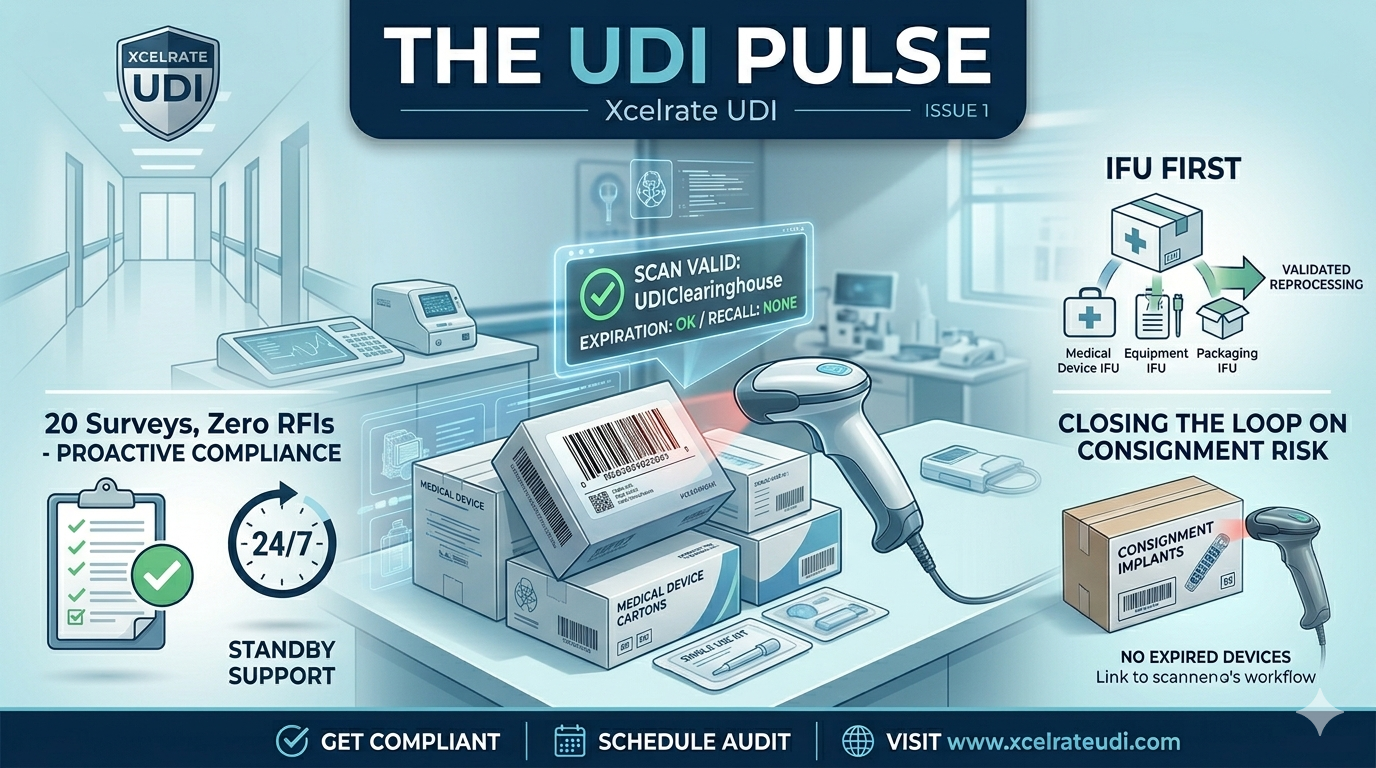
Hospitals and clinics face increasingly complex requirements for medical devices, biologics, Instructions for Use (IFUs), recalls, expiration dates, and adverse events. Managing this documentation across multiple departments while meeting strict accreditation standards is a massive operational challenge.
Too often, healthcare facilities rely on vulnerable workarounds: manual checks, representative-managed inventory, disconnected files, and inconsistent access to current manufacturer's documentation.
This issue of The UDI PULSE breaks down three critical risks currently impacting healthcare systems:
Point-of-Use Failures: Expired, recalled, or improperly labeled products reaching patients.
Reprocessing Gaps: IFU interpretation errors that compromise validated sterilization.
Survey Vulnerabilities: Readiness gaps when staff cannot immediately retrieve manufacturer instructions during an audit.
Dive into these issues and how Xcelrate UDI has helped hospitals and clinics address them seamlessly and with ease.
-
Survey readiness is not built during a survey. It is built long before the auditors arrive.
Hospitals and clinics must demonstrate that staff can access accurate, current, and manufacturer-supported IFUs at the point of need. When IFUs are outdated, unavailable, incomplete, or difficult to retrieve, even the strongest clinical teams become vulnerable to citations.
Xcelrate UDI has supported more than 20 survey events with zero IFU-related Requirements for Improvement (RFIs). During active Joint Commission windows, we proactively text and email staff to remind them how to access IFUs, request immediate help, and contact Xcelrate UDI support if a surveyor asks for documentation. We also provide 24/7 standby support, so teams never have to locate or validate documentation under pressure.
_____
Case Study: The Midnight Save During an active survey, a health system (not yet an Xcelrate UDI client) could not immediately produce a requested IFU. Xcelrate UDI stepped in and secured the document from the manufacturer. Upon review, the manufacturer's IFU was actually incomplete. We rapidly obtained a supporting letter from the manufacturer clarifying the missing information and outlining their planned IFU improvement. This verified documentation strengthened the facility's response and completely averted a final citation.
_____
True readiness should never depend on scrambling for documents while a surveyor watches. It requires a trusted system that keeps manufacturer-supported information accessible, validated, and current every single day.
Through UDIClearinghouse and IFUVitals, facilities gain immediate access to:
Manufacturer IFUs, manuals, SDS, and CE documents.
Full device registration via the FDA GUDID.
Device classification, single-use status, recall history, and adverse event logs.
Staff can retrieve critical information during audits, surveys, and daily clinical operations without relying on outdated binders, shared drives, or manual searches.
The Takeaway: Proactive readiness builds staff confidence. When teams know exactly where to find an IFU and how to demonstrate compliance, they handle survey questions effortlessly and provide safer routine patient care.
Is your facility facing an upcoming survey window? Protect your team from costly RFIs. Contact our survey readiness team at support@xcelrateudi.com or visit www.xcelrateudi.com to activate 24/7 standby support.
-
A medical device’s Instructions for Use must drive every reprocessing decision. Once the device IFU establishes the required level of pre-cleaning, disassembly, cleaning, disinfection, sterilization, handling, transport, or storage, the facility must follow those instructions exactly as validated by the manufacturer.
Think of validated reprocessing as a three-legged stool:
Medical Device IFU
Equipment IFU (e.g., washers, sterilizers)
Packaging IFU (e.g., wraps, containers)
If any single leg is missing, unclear, incompatible, or ignored, the entire process loses its validation. While manufacturer compatibility charts are helpful to cross-reference items, they are never a substitute for the medical device's full IFU.
This distinction is critical for devices that span multiple Spaulding classifications based on use, such as ultrasound transducers and probes. Partial interpretation of an IFU or over-reliance on a compatibility chart can lead to dangerous reprocessing decisions.
When a probe or transducer is used for a biopsy, operative procedure, or when its prior use history cannot be confirmed, the manufacturer’s full IFU must dictate the reprocessing method. If a device is transported between locations and its custody or cleaning history is murky, the device must receive the highest applicable level of reprocessing (such as sterilization) outlined by the manufacturer.
Managing Vendor and Loaner Risks
Third-party vendors and externally owned devices introduce significant liability. When devices enter a facility without clear documentation of prior use, cleaning, or chain of custody, you cannot guarantee patient safety. This vulnerability reinforces the need for strict, manufacturer-driven IFU compliance, documented handoff workflows, and clear compliance expectations for on-site vendors.
This is exactly why Xcelrate UDI validates IFUs and supports staff 24/7 when clarification is needed. Through IFUVitals, staff can access current manufacturer documentation across all departments. If a document is unclear, incomplete, or missing, staff can use our "Need a Document" feature to request immediate expert help instead of relying on dangerous assumptions or vague vendor guidance.
______
The Takeaway: IFUVitals removes the guesswork from sterile processing. By giving teams instant access to verified manufacturer instructions, we protect facilities from the compliance gaps associated with complex probes, transported devices, and vendor-managed products.
-
A recent sentinel event involved an expired implant being used before the nursing team had been fully trained to scan products at the point of care. This event highlights a systemic failure in representative-managed, consignment, bill-only, loaner, and trauma workflows: if products are not validated in real time, expired or recalled devices will eventually reach patient care.
In this specific case, the device was shipped in 2023 and sat in inventory until it was used past its expiration date. This outcome points to a lack of vendor inventory accountability. Had the strict vendor inventory policy been enforced with routine expiration reviews, the sales representative would have had a four-month window to identify and remove the expired device.
Two weeks later, during our on-site training and workflow review, four additional expired devices were identified and pulled from active inventory. These were high-risk, trauma-related products. Because these items are needed urgently during emergencies, manual checks are simply not enough to guarantee safety.
_____
Case Study: Uncovering Hidden Sterilization Risks
During on-site training, we identified an additional patient safety concern regarding a manufacturer's steam-sterilized medical devices. The internal sterile barrier exhibited ink bleed and labeling degradation following sterilization.
From a Sterile Processing perspective, this condition mirrors a wet tray or compromised packaging, requiring the product to be quarantined. The finding raised serious questions about whether the manufacturer's labels were properly validated for steam exposure and if their IFU adequately addressed post-sterilization acceptance criteria. Due to the risk of sterility assurance and scannability, Xcelrate UDI reported this concern directly to the FDA.
_____This lesson extends far beyond a single expired implant. It proves the necessity of moving from manual assumptions to digital, point-of-use validation. Xcelrate UDI provides facilities and vendor representatives with a unified, shared workflow for device validation, expiration monitoring, and recall tracking before a item ever touches a patient.
Through UDIClearinghouse (utilizing UDIVitals and UDIVerify), staff scan or document medical devices before a product is opened, handed off, or implanted. The system provides immediate audible, visual, and tactile warnings if it detects an expiration date, active recall, FDA registration concern, or missing UDI validation.
_____
The Takeaway: Manual inventory management is a patient safety hazard. Xcelrate UDI replaces assumptions with automated point-of-use protection, ensuring that expired or compromised devices are stopped before a surgical error can occur.
Protect Your Patients and Secure Your Next Survey
Is your facility fully protected against hidden inventory risks, reprocessing gaps, and missing IFUs? Manual workarounds put your accreditation and your patients at risk.
Xcelrate UDI bridges the gap between complex manufacturer data and your clinical staff. Whether you need to automate your point-of-use scanning, secure 24/7 standby survey support, or clear up conflicting IFU text, our team is ready to step in.
Take Action Today
Request a Compliance Vulnerability Audit: Let our experts evaluate your current vendor inventory workflows and IFU accessibility. Visit www.xcelrateudi.com/demo to schedule a consultation.
Connect on LinkedIn: Follow our Xcelrate UDI page for real-time compliance updates, FDA recall alerts, and industry best practices.
Immediate Support: If you are in an active survey window or need immediate assistance locating a missing manufacturer document, email our rapid-response team at support@xcelrateudi.com .